
Abolish The Founding!
The miracle of America is perpetual re-birth

For all their flaws, including of course slave-holding, the Founders deserve the attention we lavish on them–the statues, the historical re-enactments, the portraits on the money. Yet there’s a fixity to the metaphor of founding–of the national Big Bang–that violates our essential nature and diminishes their achievement. The framework they built, not only through the Declaration and the Constitution but through the presidency they handed from one to another, proved so resilient that a slender coastal nation of 4 million souls could transform itself, again and again, into a global colossus that (at least until our own time) still retained the essential principles that once made it the wonder of the world. The story of America is perpetual renewal–continual re-founding. We should celebrate the Founders on this 250th birthday by putting them aside.
What would it mean to think of our history this way? First, we could call a halt to the holy war over Washington, Jefferson, Madison etc., because the debate over whether America was established in the name of noble principles or white supremacy would no longer serve as a proxy for our own culture wars. We would see that that’s us, not them. The French don’t endlessly fight over whether or not Voltaire and Rousseau were paragons of reason. Their statues are right there in the front of the Pantheon, but the French don’t treat the Revolution as Year One as we do the Declaration of Independence.
Since 1789 France has had five “republics,” a term that denotes a new constitutional order. Of course we’ve only had one constitution, and unlike the French have never relapsed from republicanism to imperial rule. But the same principle applies–new beginnings in new eras. If we think of our re-foundings as demographic, cultural and political epochs, we turn out also to have had five. I’m open to alternative readings, but I would describe this story of continual unfolding as follows.
The First Republic: Anglo-America
The men who ruled America for its first half-century had been born Englishmen. They were educated as Englishmen and even rebelled as Englishmen–in the name of Whig principles of limited government and a Cromwellian scorn for monarchy. Many of them–and virtually all the New Englanders–used the word “republic” rather than “democracy” because they looked to English-style parliamentary rule to curb the spirit of the mob. For all their revolutionary fervor, they were, in the main, conservative men ruling over a circumscribed world. The leading Federalists who gathered at the Hartford Convention in 1814-5 even considered seceding rather than accept their growing subordination to both Western newcomers and Virginia Democrats. That drove the final nail into the Federalist coffin.
The Second Republic: The Age of Jackson
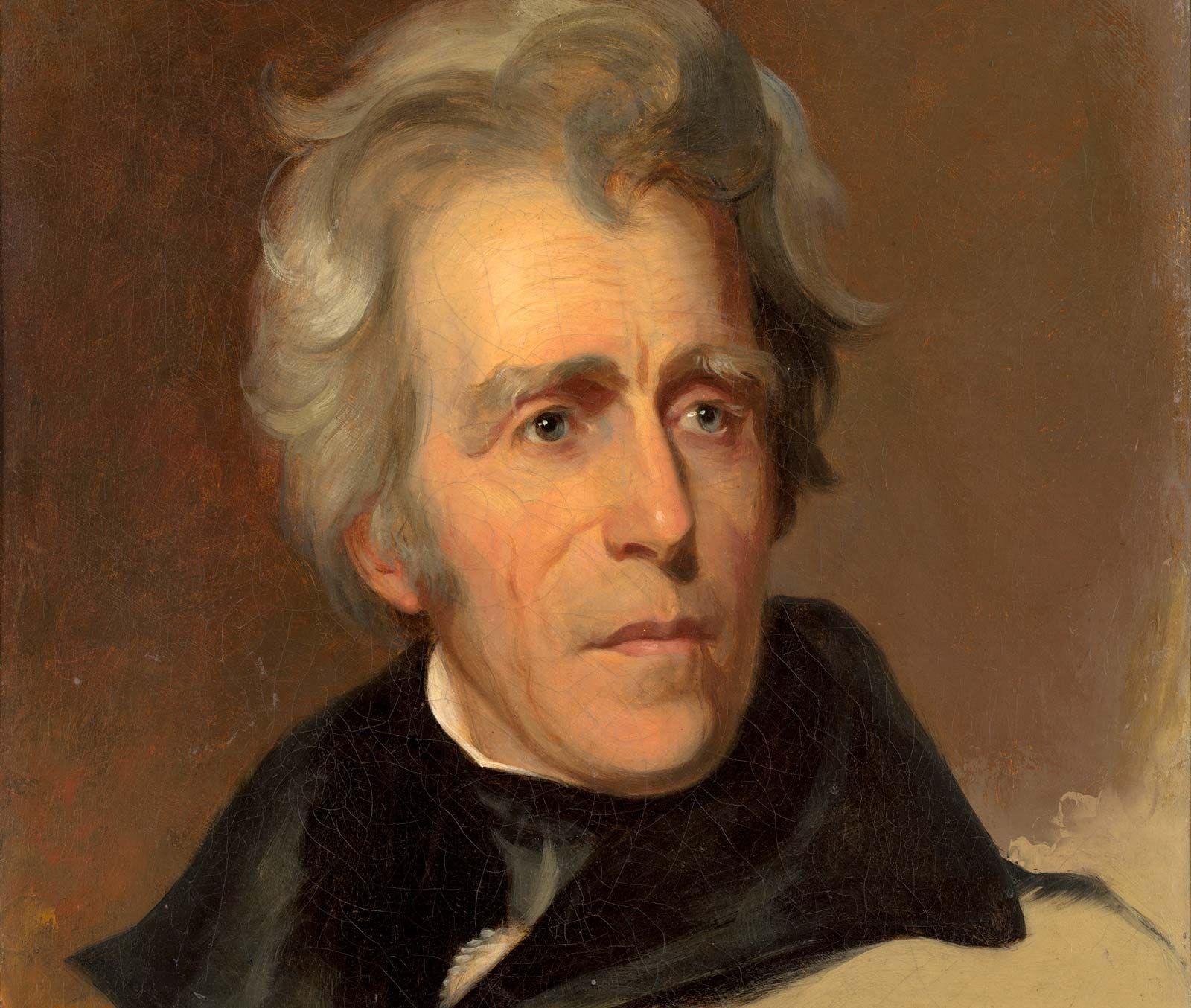
By the late 1820s the United States was well on its way to becoming a continental nation; the population had tripled since Washington was elected. Pioneers were bringing the vast and fertile Ohio Valley under cultivation. Soldiers under the command of Gen. Andrew Jackson were harrying Indian tribes from their ancestral homes and pushing them ever westwards in a brutal forced march. The election of 1828 pitted Jackson against John Quincy Adams, the surviving remnant of the New England Puritans. Jackson was a new man who represented new men. The Adams forces let it be known that Jackson didn’t know how to spell properly and had never been abroad; the same was true of many of the people who very happily voted for him. While Adams carried the Northeastern states of the original union, Jackson trounced him by winning the South as well as the new states of the West. The historian Arthur Schlesinger, Jr. described the advent of Jackson as an “age” in American history because from this time American democracy became not only a set of political institutions but a cultural fact. The new man was an instinctive democrat: an American could look any other American in the eye.
The Third Republic: Reconstruction
This is the one we know about, thanks in part to Eric Foner’s 2019 The Second Founding: How The Civil War and Reconstruction Remade the Constitution. The Civil War ended slavery, but it was the 13th, 14th and 15th Amendments that, as Foner writes, “created a fundamentally new Constitution,” enshrining in the document full rights to citizenship and voting for Black Americans. Reconstruction thus established a new republic in the French sense of the word. But did it do so in the more lasting sense that Jacksonian democracy did? Perhaps not; the Constitution changed more than the nation did. Black people continued to live in serfdom in the states of the Old Confederacy and to suffer systematic discrimination elsewhere. The transformation in life prospects that both Black citizens and the radical Republicans envisioned in the 1860s would not really begin until the 1950s, and would not truly be embedded in law until the 1960s. The legacy of slavery and second-class citizenship is with us still.
The Fourth Republic: New People In New Places
Of the fifty million people who lived in the United States in 1880, most (save Irish Catholics) were Protestant and most (save Blacks) were Anglo-Saxon. By 1920, 28 million newcomers had arrived, mostly from countries that had sent few people in the past: Russia, Poland, Italy, Greece. The America of 1880 had 250,000 Jews; by 1920, the figure was four million. The immigrants not only changed America’s complexion but made the country vastly more urbanized and vastly more wealthy: Chicago, Cleveland, Milwaukee and Detroit became giant centers of industry as immigrants poured in and took low-level factory jobs. The immigrants shattered the proprieties of American popular culture. The Jews made movies and Broadway shows and popular music. The Italians taught America how to eat and drink and enjoy themselves. The new professional sports leagues filled up with brawny young men who discovered they could make a living hitting each other. New York City, which seemed to have more of every kind of people than anywhere else, became the undisputed capital of America.
The Fifth Republic–Liberal Superpower
The United States emerged from World War II as by far the world’s dominant economic and military power. And with supremacy came a sobering realization: “We are now concerned with the peace of the entire world,” as Gen. George C. Marshall put it. A continental nation removed from the world’s turmoil by two oceans would now become the world’s law-giver. The United States had refused to join the League of Nations; now it served as the home, and the animating force, of the United Nations. The U.S. and the UK created the economic institutions that were meant to ensure economic stability and prevent ruinous trade wars: The World Bank, the International Monetary Fund, the General Agreement on Tariffs and Trade. With the rise of the Cold War, Washington designed a new security architecture along with its allies–not only NATO but other, lesser, regional bodies. George Washington had admonished Americans to “steer clear of permanent alliances with any portion of the foreign world.” That era of our history had come to an end. America was a hegemon–if a relatively benevolent one.
That is, in snapshot, our story on the eve of the 250th anniversary of our founding. The great theme is not fidelity to origins but adaptation and the embrace of dynamism. America utterly changed its geography, its demography, its political order, its culture and its place in the world. Today we fear that that story has come to an end. We’ve never before had a president whose slogan-”Make America Great Again”--asks us to look backwards rather than forwards. It is possible that Donald Trump is, or at least incarnates, the end of everything–of our collective sense of possibility, our native optimism, our sense of shared purpose and, yes, our belief in the founding principles. Perhaps there won’t be a sixth republic–at least not for a very long time. Republican rule in France gave way to autocracy for much of the nineteenth century. Nothing lasts forever.
Bravo on some original thinking here on Substack (of all places). 👏